You're in Google's map. Are you in its AI answers?
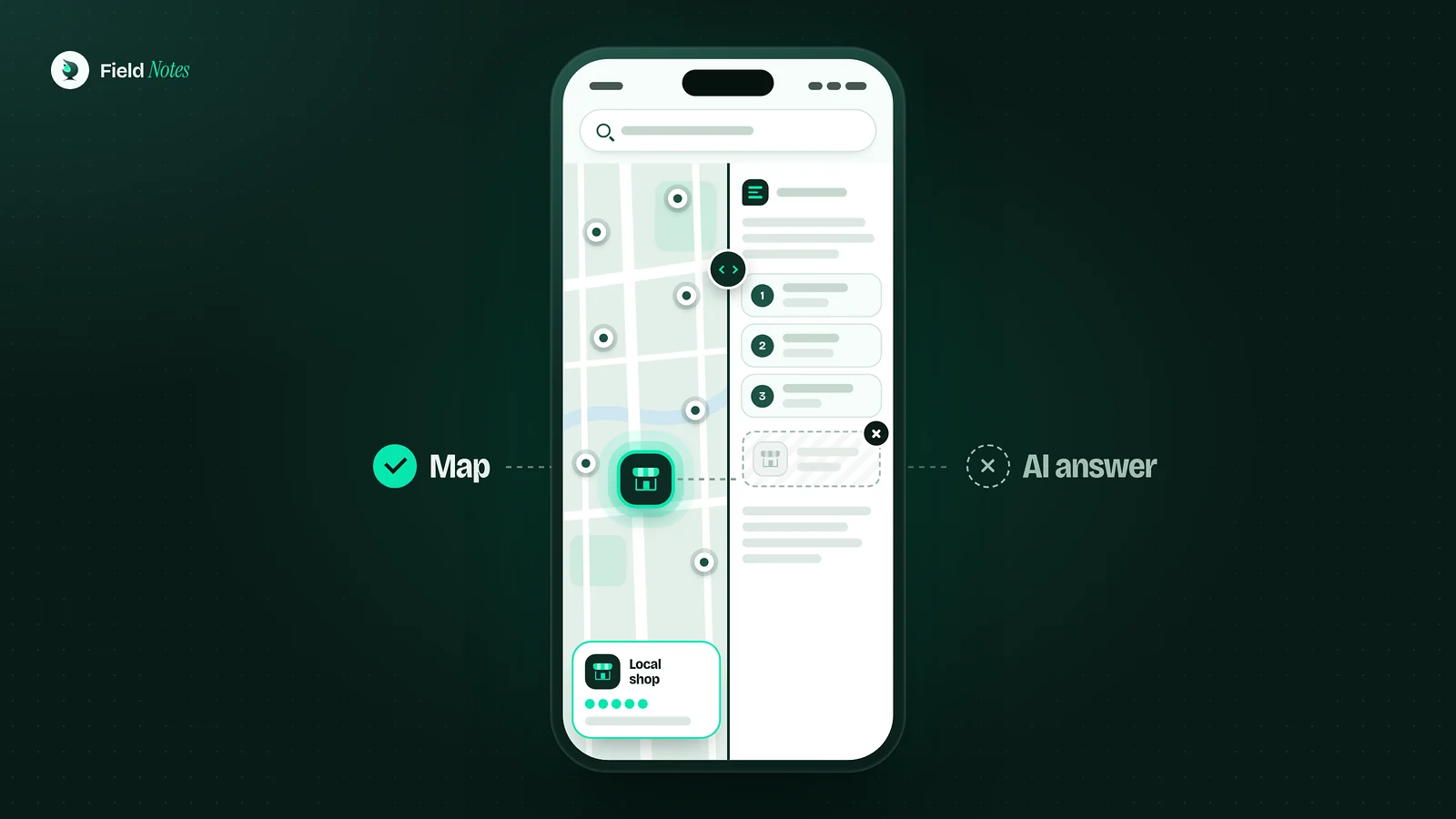
For years, local search on Google came down to one question: do you show up in the map? If someone in Peru, LaSalle, or Ottawa searched “vet near me” or “pizza in Streator” and you were in those top map spots, you got the calls.
That’s still true, but it isn’t the only place people look anymore. Google’s AI Mode gives searchers a written answer that names businesses, and it doesn’t always name the same ones the map does.
What the numbers say
BrightLocal, a local SEO software company, looked at more than 200,000 local searches for 1,300 business locations across ChatGPT, Google AI Mode, and Google’s AI Overviews (BrightLocal study, Sep 2026). Google Maps named the businesses they were tracking in 66% of searches. AI Mode named them in 32%.
The AI answers also moved around a lot. When BrightLocal ran the same search again, AI Mode’s list of businesses was only about 21% the same from one run to the next. The map barely changed.
Google changes these features all the time, so treat the exact numbers loosely. But the takeaway is clear enough to act on: ranking in the map doesn’t mean you’re covered.
Why this matters for a local business
Most of our clients don’t think about “search engines.” They think about the phone ringing.
Someone asks Google, “Who does document shredding near Peru, IL?” or “Which vet in the Illinois Valley takes walk-ins?” If AI Mode answers with three names and yours isn’t one of them, that person may never scroll down to the map. They call whoever was named.
You won’t see that in your reviews or your inbox. It’s a call that never happened.
What we look at for clients
We don’t know exactly how Google picks the businesses it names in AI Mode, and anyone who says they do is guessing. Google’s own guidance says a Google Business Profile can help a business show up in AI answers as well as regular search (Google Search Central). So we make sure Google has clear, consistent, complete information to work from, and then we check both places your customers are looking.
For local businesses, that means:
- A complete Google Business Profile, with accurate hours, the right categories, real photos, and services listed in plain words.
- Service pages that answer real questions. “Do you pick up?” “What areas do you cover?” “How fast can you come out?” If the answer isn’t written down anywhere, Google can’t repeat it.
- Matching information everywhere. Your name, address, and phone should be the same on your site, your profile, and the directories you’re listed in.
- Reviews coming in over time. Ask happy customers to mention what you did and where. A review that says “they shredded our files in Ottawa the same day” tells Google more than “great service.”
- Checking both results. We look at whether you show up in the map and in AI Mode for the searches that actually bring you work, not just one or the other.
None of this is a trick. It’s the same work that’s always mattered in local search, done carefully and checked in more than one place.
What Google says actually helps
Google published a guide for site owners on showing up in AI Overviews and AI Mode (Google’s AI optimization guide). AI answers are built on the same search systems as regular results, so regular SEO still applies. For a local business, the guide comes down to this:
- Write what only you can write. Google says a first-hand review brings a perspective from real experience, while a summary just restates what’s already online. A page about how you handle a same-day shred job in Ottawa says something “5 tips for document security” can’t.
- Use your Google Business Profile. Google says Business Profiles can help your services show up in AI answers as well as regular search results.
- Make sure Google can crawl your pages and show them in search. A page that isn’t in Google’s index can’t show up in an AI answer.
- Make the site work well on a phone, load fast, and keep your main content easy to tell apart from everything else.
- Add real photos and video. AI answers can pull those in too.
- Check the Generative AI performance report in Google Search Console to see how you’re showing up.
What Google says you can skip
A lot of people now sell “AEO” or “GEO” services (answer engine and generative engine optimization). Google says many of the popular “hacks” aren’t effective or supported by how its search works, and lists a few you can ignore:
- An llms.txt file or other special AI files. Google Search doesn’t use them.
- Chopping pages into tiny chunks. Google can find the right part of a longer page, and there’s no ideal page length.
- Rewriting pages just for AI. Google understands synonyms, so you don’t need every keyword variation.
- A separate page for every way someone might phrase a search. Google says doing that to game results violates its scaled content abuse spam policy.
- Chasing fake mentions around the web. Google says it isn’t as helpful as it might seem, and its other systems block spam.
- Special schema just for AI. Structured data isn’t required for AI answers, though it still helps with rich results.
That lines up with what we already do. The work that gets you named in AI answers is the same work that gets you found in search: a complete profile, pages that answer real questions, and a site Google can read.
A quick test you can do today
Pull up Google on your phone and search the way a customer would: your main service plus your town. Look at the map results, then try the same search in AI Mode if you have it. Write down who shows up in each one.
If you’re in one and not the other, or in neither, that’s worth knowing now rather than after a slow month.
Want us to check where you stand?
We're in Peru, IL, and we help Illinois Valley businesses get found and get the call. We'll check your map listing and AI Mode results for the searches that bring you work, and show you what we'd fix.